Knowledge, Information and Learning

After a beautiful discussion with the initial framing of knowledge, information & learning. I really opened myself up to others ideas whilst also allowing for the flow of my own thoughts, feelings, ideas and realisations to come into form, shape & then be dissolved again if I felt necessary. Here is a brief over view of some of the concepts that I've began to ponder:
Goal Orientated Learning -
Taken from the notion that we need a specific reason or purpose to be able to commit & complete the task of learning, engage in the correct way & apply the appropriate amount of energy for the perceived outcome (Ames & Archer, 1988; Meece, Anderman, & Anderman, 2006). I started to recognised the fact that if we become overly fixed on the objective of learn i.e. the goal, we are potentially missing the opportunity to a multitude of experiences, which would further enhance our practice as well as allowing for the spontaneity & space for more subjective, wholesome & rounded learning to take place.
Model of goal orientations
MASTERY GOAL - Focus on mastery of learning - approach focus: learn from errors, judge performance based on standards of self-improvement and progress
PERFORMANCE GOAL - Focus on outperforming other - approach focus: errors indicative of failure, judge performance based on normative standards of being the best performer
MASTERY GOAL - Focus on avoiding not mastering task - avoidance focus: errors indicative of failure, judge performance based on standards of not being wrong
PERFORMANCE GOAL - Focus on avoiding failure - avoidance focus: errors indicative of failure, judge performance based on normative standards of not being the worst performe
This above framework from Elliot & McGregor, 2001 - is a brief breakdown of how goal orientated learning can be broken down further & into 4 sub categories performance avoidance, performance approach, mastery avoidance, mastery approach. Further research into these areas has demonstrated that if the goal is to purely mastery or avoidance of a performance i.e. a set task, then the outcome results in the learner having 'poor persistence, high anxiety, use of superficial strategies, and low achievement' (Linnenbrink, 2005; Urdan, 2004; Wolters, 2003, 2004). With performance avoidance having the most negative impact on the learner, the transference of skills & the long term memory of the skill. This further implies that when thinking about learning we shouldn't necessarily be so 'set in our ways' around what it is that we are wanting to learn. But rather come in with an open mind-set, allowing for freedom of exploration as well as the awareness that we will learn from our 'mistakes' in a positive way.
The environment in which learning takes place. -
Personally I have felt that majority of the learning environments which I have placed myself into have not been necessarily that productive for me. Being more of a kinesthetic learning the typical classroom environment hasn't produced the best result, as well as being one in which I find intimidating & anxiety inducing - which from a physiological & biochemical perspective would produce too much cortisol & over arousal meaning the information being taught wouldn't be able to be understood as the body is in a flight-fight-freeze response. Rather then rest-digest-reproduce state, one which is more conducive to learning. Therefore upon further reading I've discovered there are different types of learning environment are used to meet the learnings needs & objectives at that time.
Learner centred - also know as "culturally responsive,” “culturally appropriate,” “culturally compatible,” and “culturally relevant” (Ladson-Billings, 1995). The term also fits the concept of “diagnostic teaching” (Bell et al., 1980): attempting to discover what students think in relation to the problems on hand, discussing their misconceptions sensitively, and giving them situations to go on thinking about which will enable them to readjust their ideas (Bell, 1982a:7). Teachers who are learner centered recognize the importance of building on the conceptual and cultural knowledge that students bring with them to the classroom -
Knowledge centred - (these) environments take seriously the need to help students become knowledgeable (Bruner, 1981) by learning in ways that lead to understanding and subsequent transfer; knowledge-centered environments also include an emphasis on sense-making—on helping students become metacognitive by expecting new information to make sense and asking for clarification when it doesn’t (e.g., Palincsar and Brown, 1984; Schoenfeld, 1983, 1985, 1991); (they) also focus on the kinds of information and activities that help students develop an understanding of disciplines (e.g., Prawat et al., 1992).
Assessment centred - The key principles of assessment are that they should provide opportunities for feedback and revision and that what is assessed must be congruent with one’s learning goals
Community centred - the degree to which environments are community centered is also important for learning. Especially important are norms for people learning from one another and continually attempting to improve.... At the level of classrooms and schools, learning seems to be enhanced by social norms that value the search for understanding and allow students (and teachers) the freedom to make mistakes in order to learn (e.g., Brown and Campione, 1994; Cobb et al., 1992)
So with consideration to this when creating & entering a learning environment the most important factor is the sense of safety. Creating a comfortable & safe space for which the student/client can engage, ask questions, 'fail', re try or simple just be. Where they can enter into a conversation, open up to the possibility of learning, whilst connecting to their own teachings & knowledge/wisdom.
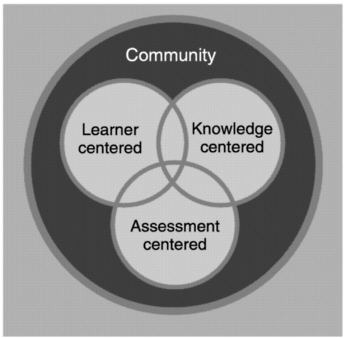 |
| Perspectives on learning environments. SOURCE: Bransford et al. (1998). All citation from The Design of learning environments |how people learn; brain mind, experience, schools; expanded edition - https://www.nap.edu/read/9853/chapter/10#144 |
Transactional & Transitional Information -
Building upon this idea of learning being a dialogue, a transference of information & the sharing of knowledge - a community/learner centred environment? - we can then recognise that all parties within the learning environment have the ability to share information, knowledge and wisdom & become open to possibilities this can offer. This idea of information, knowledge & learning being a one way flow i.e. the teacher/instructor/therapist being the only one that can teach I find void, especially in terms of my disciple & practice. For me, I try to enter each environment with the awareness that I don't hold all the answer, nor can fix all the problems but instead become receptive to the other opportunities to engage, enhance & develop from that situation. Upon reflection the times that I've found this particularly hard is when I'm brought into a job as the fixer/teacher/answer holder, a role that I don't feel comfortable, I prefer to facilitate their learning/healing which I feel then further enhances my practice & ability to do a more successful role as facilitate next time. One notion that I've since been thinking about is - information overload. We all have the access to so much information now, though the internet, access to more learning materials, trainings, podcasts etc, could it disconnecting us from our inner knowing, from that internal compass. Resulting in a second guessing effect? Feeding into a fear of not knowing enough, having the answer? Or even being able to retain more information? Current research suggests that the surging volume of available information—and its interruption of people’s work—can adversely affect not only personal well-being but also decision making, innovation, and productivity. In one study, for example, people took an average of nearly 25 minutes to return to a work task after an e-mail interruption. That’s bad news for both individuals and their organizations. (Harvard Business Review - https://hbr.org/2009/09/death-by-information-overload). Personally, I listen to a fair amount of podcast and read a fair amount of text, the research mentioned above does not surprise me, I am aware that at times I don't know where/when or in what context I heard something. As well as at times causing me to doubt the best way to work with a client or even what suggestions to make because of information overload, conflicting views on subjects matters & me not being able to trust my own opinion.
Knowledge v's Wisdom. -
This hypothesis is something I came across many years ago and is something I deeply connect to. Knowledge being skills, facts or information acquired though theoretical understanding, the sum of what is known/familiarity or awareness about a fact or situation. Wisdom, on the other had is having multiple experiences and insights around the knowledge based subject. It is through the process of learning, understanding & applying coherently the skill/information or fact multiple times that we then become wise and thus create wisdom. This regards to the concepts currently discussed I find is one a linking threads, even though we shouldn't become set in our ways or even have the belief that we are the wisest or most knowledgable about a situation. Having the wisdom to know that the client/student is as much the teacher/facilitator as we are. Wisdom could be considered the outcome of learning the information beyond a state of knowledge but into a state of embodiment, applications and successful adaption & evolution. But then as Socrates so beautifully puts it:
"The only true wisdom is in knowing you know nothing".
Assumptions, Prejudges, Predetermined Expectations -
Habitual bias and unconscious bias are the ideologies & beliefs that we innately hold without even knowing. Theses influence our conscious chooses in every moment & therefore impact how and what we see in the world. A prejudice of any sort will restrict the outcome of an event, cause a lack of flexibility in thinking & hinder the ability to communicate the idea efficiently & effectively. Expanding on this further we also began to discuss the assumptions we hold about our practice, the interpretation of our practice by others and then the way we share our practice due to the environment and our assumptions surrounding that. Both of these then feed into the idea of then having predetermined expectations - due to our the innate biases & our presumptions when we are entering the teaching/learning/knowledge sharing/practice environment having already decided how the outcome of the event should be. Whether that be the student/client learning in a particular way, reacting in a certain way to a session or even expecting conflict or hostility. Upon reflection is something that I have a great concern about due to not necessarily being able to explain my practice very well and at times coming into an already established team environment for a short period of time. As well as the expectation for a clients/student body to move, heal and flow in the way I anticipated. Reading around these ideas I've come into further psychological texts about the way we presume and predetermine a situation based on our biases. These biases are generally broken down into 3 areas:
Confirmation Bias - interpreting information to already fit your preconceived ideas/projections of the outcome
Anchoring Bias - jumping to conclusions about the outcome of a situation due to factors along the way and therefore not allowing for other possibilities
Overconfidence Bias - predicting the outcome of a situation due to your own beliefs without taking in information from other sources.
From my understanding of these, the best way to then approach and break the cycles of biases, presumption, expectations and the limiting results that these can yield. Are to firstly reflect and notice what biases we have, recognise and understand where & how they came into existence & what impact they are causing, open up, create space & consider new ways of being or entering a situation then start to incorporate these new ways of being. Quite a lot of mindfulness, meditation and CBT or DBT is about pausing before a reaction. I find this very appropriate when talking about breaking habits/biases - assumptions, prejudges, predetermined expectations. The pause before we react allows us to then act from a place of awareness with more consciousness.
Dr. Patricia Devine and Dr. William Cox, psychology researchers at the University of Wisconsin, Madison. have devised a model to start the process of breaking habitual biases. Studies using this model have shown that across a multitude of group workshop settings it has made a positive impact. The model is as follows:
 |
| https://gradschool.duke.edu/professional-development/blog/breaking-bias-habit-evidence-based-intervention-duke-s-biology |
What I find quite interesting about this model in particular is the sharing aspect of it - communicating with others about how you are breaking your habitual cycles & using an external input to help strengthen the and create a positive feedback loop - something which I already noticing is impacting my practice with these study/discussion groups.
So in conclusion of what I found an incredible insightful & thought provoking discussion, I can see how one of my main faults in my practice is the prejudices and assumptions that I hold about how I am going to be received into an environment and outcome, in terms of the way movement is felt & it impacts the client/student. Especially as most of my practice is me entering anothers' environment.
Also, I enjoy the idea and notion around turning different levels to information, knowledge, understanding & wisdom the continual and every changing trajectory. As well as understanding in more depth the requirements for effective learning whilst still allowing for the spontaneity and space. Sometimes simply arriving, fully present and responding with consciousness and passion is the best form of my practice.


Dear Imogen, thank you so much for sharing all your thoughtful reflections. Such a lovely and informative post! I am really drawn to the topic of goal oriented learning...may I ask you kindly the title of the book you are referring to? I would love to check it out! Thank you so much! And have an amazing day!
ReplyDeleteHey Elly, so much of the goal orientated learning theory was from knowledge I acquired during a level psychology and sports. But if you lookninto the framework from Elliot & McGregor, 2001 then you'll come across the approaches theory x
Delete